
The air fryer vs oven debate usually turns into a religious argument, but it is really an energy question with a clear answer: for small everyday loads, the air fryer wins on cost, speed, and crisping; for big batches and baking, the oven wins and often costs less per serving. Here is the actual math, using 2026 prices and real wattage, so you can see exactly where each machine earns its place.
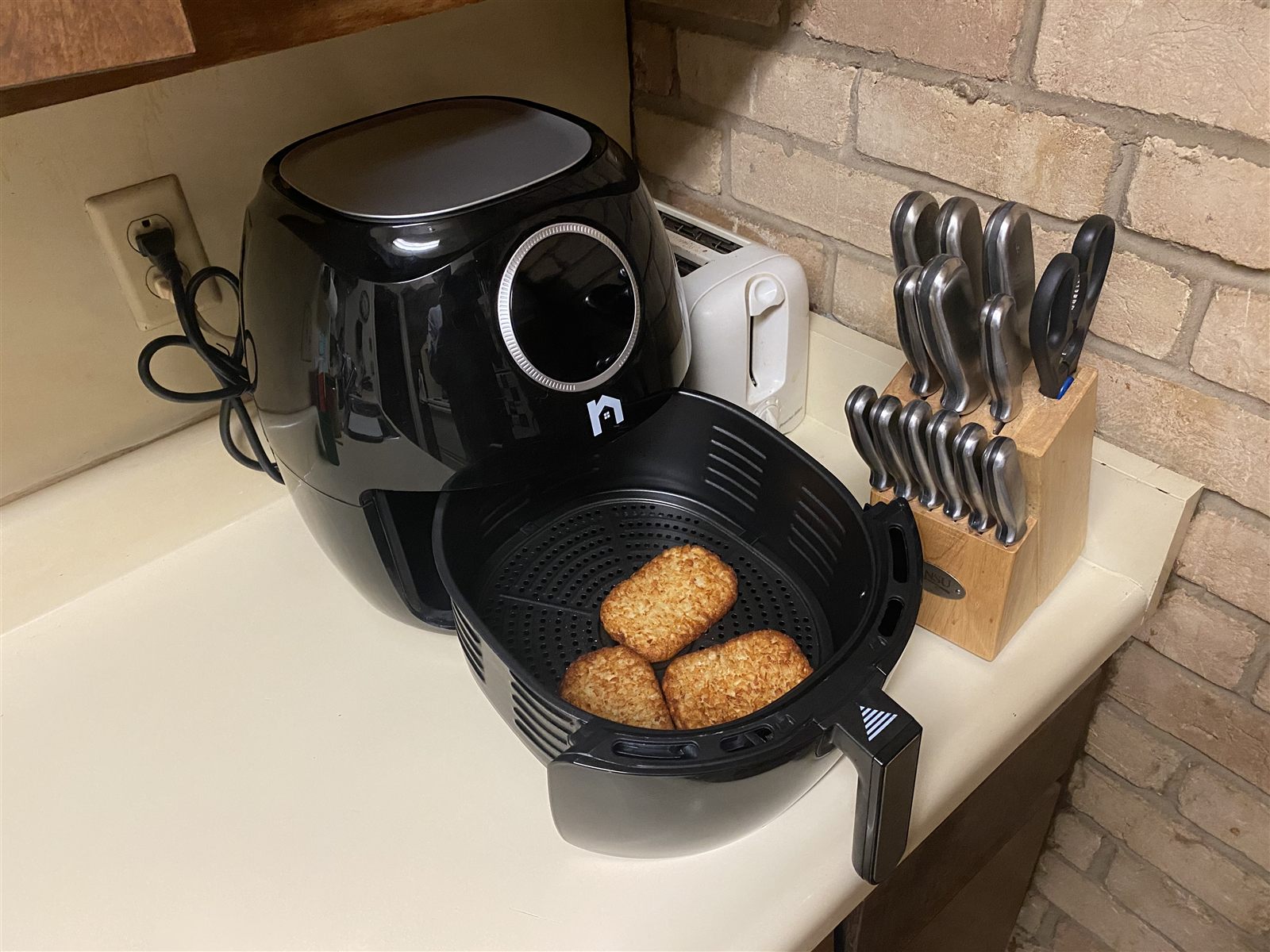
Air fryer vs oven: the energy math
The numbers that matter are wattage and cavity size. A typical countertop air fryer draws 1,400 to 1,700 watts and heats a basket-sized cavity in under three minutes with no meaningful preheat. A household electric oven draws 2,000 to 3,500 watts, takes 10 to 15 minutes to preheat, and heats a cavity about 30 to 50 times larger than the air fryer’s basket.
Run the numbers at a typical US electricity rate of about 17 cents per kWh:
- Air fryer, 20 minutes at 1,500W: 0.5 kWh, roughly 9 cents
- Electric oven, 10-minute preheat plus 20 minutes at 2,400W: about 1.2 kWh, roughly 20 cents
That gap matches what UK testers found this year: comparison sites putting a 30-minute air fryer run at around a third of the cost of the same time in an electric oven. Over a year, if your household swaps four oven-cooked meals a week for air fryer versions, the saving lands around 40 to 50 dollars at US rates – modest but real, and it compounds with the time saved.
One honest note: if your big oven is gas, the math tightens. Gas ovens run cheaper per hour than electric ovens in most markets, so the air fryer’s win shrinks – though it still wins on preheat time and on not heating up the whole kitchen.
Why the air fryer wins small loads
The air fryer is not actually frying anything. It is a small convection oven: a compact coil, a strong fan, and a tight basket. Physics favors it for one-to-four servings because:
- No real preheat – the tiny cavity reaches 400F in about three minutes
- High-velocity air crisps surfaces faster than a passive oven at the same temperature
- Less kitchen heat – in summer, an oven pushes a room’s worth of hot air into your kitchen and your AC bill
For frozen snacks, roasted vegetables, chicken pieces, reheating pizza, and single-pan weeknight proteins, the air fryer is the cheaper tool and the faster one. Testers at Bon Appetit, Serious Eats and The Kitchn converged on the same capacity advice this year: a 5 to 6-quart basket covers most households, and dependable models start near 50 dollars with the best around 100 to 200.
When the oven is actually cheaper
Flip the load size and the math flips. The oven’s cost problem is that you pay to heat a big cavity whether you cook one tray or four. So the more you cook per run, the less each serving costs:
- Four servings in one oven run at 1.2 kWh: about 5 cents of electricity per serving
- Four servings as two air fryer batches at 0.5 kWh each: about 9 to 10 cents of electricity per serving
The per-serving gap narrows when you count your time standing in the kitchen for multiple air fryer batches. And some jobs simply belong to the oven: a sheet-pan dinner for six, two racks of roasting vegetables, a whole chicken, anything in a wet batter (the fan blows coatings around), bread loaves that need rising room and steady crust development, and of course the entire holiday baking season. Cookies, cakes and sheet bakes are oven territory – an air fryer cannot hold a half sheet pan, and there is no version of “twelve cookies on one tray” that fits a 6-quart basket.
The upfront cost question
Your oven’s upfront cost is zero – it came with the kitchen. The air fryer is a 50 to 200 dollar purchase depending on size and features. At a realistic saving of 40 to 50 dollars a year for a household that genuinely uses it weekly, a 60 dollar air fryer pays for itself in about 15 months. A 200 dollar top-shelf model with dual baskets and smart features is a convenience purchase, not an investment – the electricity alone will not justify it for most families.
That makes the decision unusually clean: buy an inexpensive, well-reviewed 5 to 6-quart model, use it for the small jobs it excels at, and let the savings pay you back. If it ends up unused in a cabinet, you are out 60 dollars – not a countertop appliance mistake costing four figures.
Food quality: where each machine is honest
The air fryer’s strengths are real: crisp surfaces with a fraction of the oil, fast reheats that keep texture (a pizza slice in three minutes beats a soggy microwave result every time), and reliable roasted vegetables. Its weaknesses are structural: small capacity, a fan strong enough to blow light food around, no real baking room, and an audible fan for the whole cook. The oven is slower and costs more per small meal, but it is the only tool for big batches, bakes, braises, and anything that needs gentle, even, quiet heat.
The verdict
Own both. That is the answer nobody makes money saying, and it is the truth. They are not substitutes; they overlap by maybe 30 percent. The air fryer is the weeknight small-load workhorse that cuts electricity and time; the oven is the batch machine and the only baker in the house. Use the air fryer for one-to-four servings and frozen-roasted-crispy jobs, use the oven for baking, big trays, and anything that needs real volume, and you will get the cheap parts of both without stretching either machine past what it is good at.
Fitting both machines into the kitchen
Where you store these two machines decides how much you actually use them, so give each a working home – our five-zone pantry method puts the everyday machine on the counter and the special-occasion one in reach. And when the oven’s side of the ledger comes due – the holiday baking season – the oven plus a good mixer is the combo that earns its keep: start from the six base cookie doughs and every oven-hour turns into cookies worth far more than the electricity.
Leave a Reply