
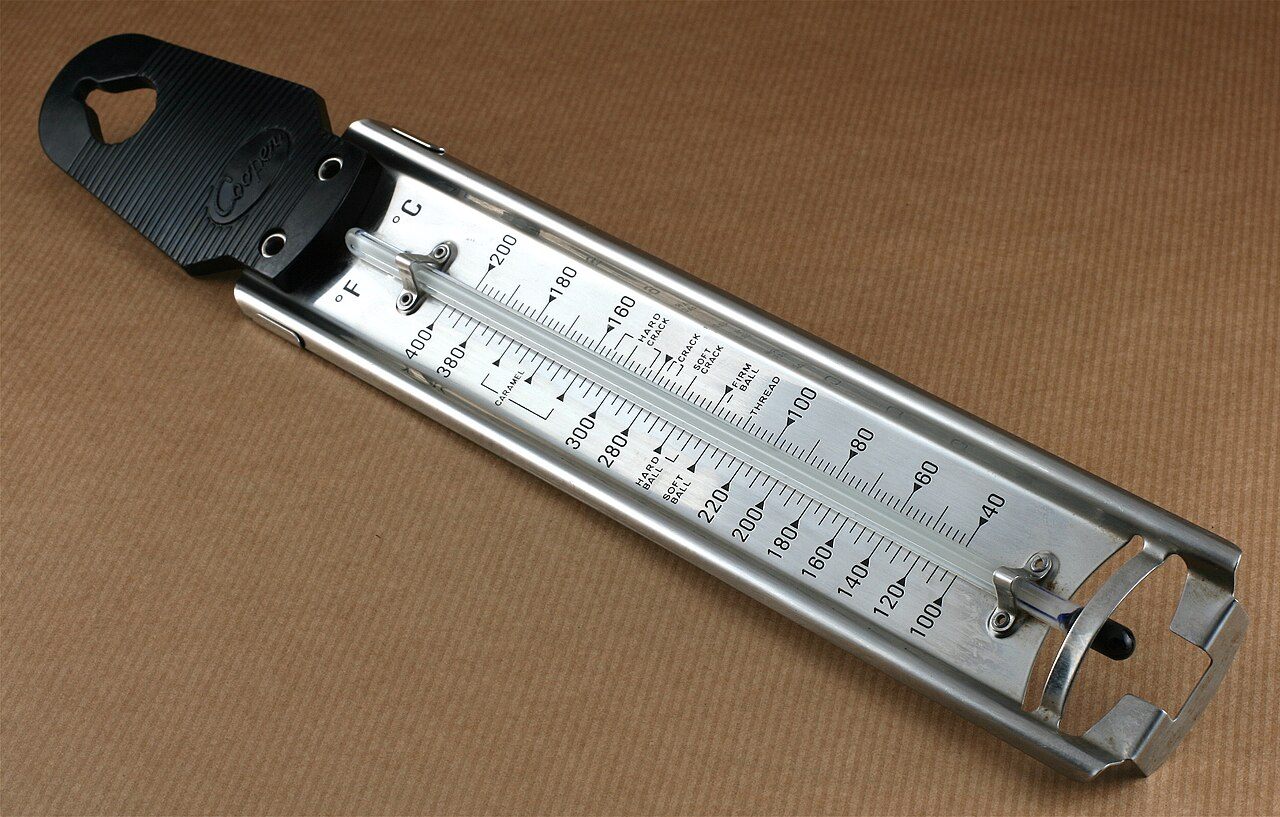
Candy thermometer stages are the temperature checkpoints every sugar recipe is secretly built around – miss one by ten degrees and fudge turns gritty, caramel turns rock-hard, and toffee never sets. A candy thermometer reads these stages for you, and every stage has a name: thread, soft ball, firm ball, hard ball, soft crack, hard crack, and finally caramel. Each name marks a precise sugar concentration – from 80 percent water-evaporated syrup up to nearly 100 percent pure molten sugar – and each one makes a different candy. This guide maps every stage to its exact temperature, what it looks and feels like in cold water, and which classic recipe lives at each stage.
The Candy Thermometer Stages, From Thread to Hard Crack
Every stage on the thermometer is really just a sugar-concentration checkpoint. As syrup boils, water evaporates and the temperature climbs – and each temperature band locks in a specific water content, which is what determines whether your finished candy snaps, chews, or melts. Here is the full ladder:
- Thread – 230 to 234 F (110 to 112 C), about 80 percent sugar: the syrup drips in a fine thread from a spoon and is still mostly liquid. This is syrup territory, not candy – jellies and preserves, and the starting line for everything else.
- Soft ball – 234 to 241 F (112 to 116 C), about 85 percent sugar: the classic fudge stage. Dropped in cold water, the syrup flattens into a soft ball you can squeeze. This is also where fondant, pralines, and buttercreams live.
- Firm ball – 244 to 248 F (118 to 120 C), about 87 percent sugar: holds its shape but dents with pressure. Soft caramels are made here – the ones that chew instead of shatter.
- Hard ball – 250 to 266 F (121 to 130 C), about 90 percent sugar: the ball is firm and only slightly sticky. Nougat, marshmallow, gummies, and rock candy bases pull off the heat here.
- Soft crack – 270 to 289 F (132 to 143 C), about 95 percent sugar: in cold water the syrup pulls into threads that bend before breaking. Salt water taffy gets its famous stretch at this stage.
- Hard crack – 295 to 309 F (146 to 154 C), about 99 percent sugar: threads snap clean and brittle. Toffee, lollipops, peanut brittle, and pulled-sugar work all finish here – past this point there is almost no water left.
- Caramel and beyond – 320 F (160 C) and up: clear liquid at 320 F, amber caramel around 338 F (170 C), and burnt sugar by 350 F (177 C). Most home candy thermometers top out at 320 F, and the burnt line is exactly why.
Why Temperature Equals Sugar Concentration
The whole system works because of boiling-point elevation: sugar dissolved in water raises the boiling point, and the more concentrated the syrup, the hotter it has to boil. So a thermometer is really a sugar-concentration gauge. That is also why a recipe can say “cook to 240 F” instead of “cook until 85 percent sugar” – the two statements are the same thing. Higher temperature, less water, harder candy. Lower temperature, more water, softer candy. There is nothing else to memorize.
The stage names themselves are fossils from before thermometers were cheap. Cooks dropped a bit of syrup into cold water and read the result: a smooth squeezeable lump was a “ball” stage, pliable threads meant “soft crack,” and snappy threads meant “hard crack.” The cold-water test still works today and has one genuine advantage – it self-adjusts for altitude, which no fixed thermometer reading does.
Using a Candy Thermometer Correctly
- Clip it to the pan, tip submerged, not touching the bottom. Touching the pan bottom reads the metal, not the syrup – and the metal is always hotter. That single mistake is behind most scorched caramel.
- Calibrate first: boil plain water. Water boils at 212 F at sea level; if your thermometer reads something else in rolling water, note the offset and cook to your target plus or minus that offset.
- Altitude cuts the boiling point roughly 1 F per 500 feet. At 5,000 feet, water boils near 202 F – so every stage lands about 10 degrees lower on your dial. The cold-water test handles this automatically; a thermometer does not. If you bake at elevation, calibrate on the day.
- Do not stir once the syrup boils in most recipes – crystallization starts on disturbed syrup edges. Wash down pan sides with a wet pastry brush instead.
- Keep it clean between stages. Hardened sugar on the probe reads falsely low. Wipe it before re-testing.
Matching the Stage to the Recipe
When a recipe says “soft ball stage” it is not decoration – it is the specification. Fudge cooked to hard ball turns dry and crumbly; toffee pulled at soft crack never sets. A few anchors worth remembering: fudge and fondant at soft ball, chewy caramels at firm ball, nougat and marshmallow at hard ball, taffy at soft crack, brittle and lollipops at hard crack. The same logic explains why maple syrup grades behave differently in baking – syrup concentrates run at the low, watery end of the ladder, far below any candy stage, which is why maple alone cannot make caramel without a long, watchful boil.
Sweetener swaps change the ladder too. Honey and sugar substitutes in baking carry extra water or different sugars, so the same stage arrives at a different dial reading – test those recipes by texture in cold water first, then translate to temperature once you know where they land.
Two Safety Rules That Are Not Optional
Boiling syrup runs 150 to 177 C (300 to 350 F) – hotter than almost anything else in a home kitchen – and molten sugar sticks to skin instead of rolling off. Wear long sleeves, keep kids and pets out of the room, and have a bowl of ice water nearby: if hot syrup touches skin, plunge immediately and keep going, because sugar burns are deep. Second rule: brown liquid past 340 F is caramel flavor, black smoke is burnt sugar, and burnt sugar smoke can flash – if a batch goes past dark amber, slide the whole pan off the heat and walk away rather than trying to save it. The pan can be soaked clean; the kitchen organization schedule does not include a fire drill.
And when the stages become routine, they quietly upgrade everything else you bake – the same concentration logic behind the doughs in our christmas cookie recipes is what keeps fudge creamy and brittle snappy. Learn the ladder once and every sugar recipe stops being a leap of faith: the thermometer names the stage, the stage names the texture, and the texture is the whole point.
Leave a Reply